Glimpses from India and around the world that will make you smile and cry.

Investigations said the accused was engaged in sharing classified details, including troop deployments and strategic locations, posing a threat to national security.
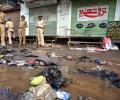
A special court, in its acquittal order in the 2008 Malegaon blast case, has highlighted a running battle between the Maharashtra Anti-Terrorism Squad (ATS) and the National Investigation Agency (NIA), pointing out stark contradictions in their probe.
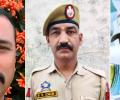
Balwinder Singh Chib, a police officer in Jammu and Kashmir's Kathua district, was killed in an encounter with Pakistani terrorists, continuing a legacy of sacrifice that spans three generations of his family. Chib's great-grandfather and uncle were also martyred in the line of duty, and his brother died during World War I. The family is venerated in their village for their history of patriotism and sacrifice.

Union Minister Amit Shah on Wednesday introduced three Bills in Lok Sabha for the removal of prime minister, chief ministers and ministers arrested on serious criminal charges for 30 days, drawing fierce protests from the Opposition as the draft laws were referred to a Joint Committee of Parliament. Three House marshals formed a protective ring around Shah. Even after the House was adjourned, the Opposition members continued with the sloganeering.

Lieutenant Colonel Prasad Purohit, acquitted in the 2008 Malegaon blast case, received a grand welcome upon his return to Pune. Supporters celebrated his acquittal after a special court noted a lack of reliable evidence against him.
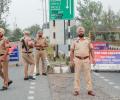
People in some border villages of Ferozepur district in Punjab began moving to safer areas amid soaring tensions between India and Pakistan.
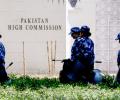
Pakistan has expressed condolences over the deaths of tourists in a terror attack in Pahalgam, Jammu and Kashmir, that killed 26 people. The Foreign Office spokesperson said Pakistan is concerned at the loss of tourists' lives and wished the injured a speedy recovery. The attack, claimed by The Resistance Front (TRF), a proxy of the banned Pakistan-based Lashkar-e-Taiba (LeT), is the deadliest in the Valley since the Pulwama strike in 2019.

The ruling NDA is expected to win the upcoming election for the post of Vice President of India, following the resignation of Jagdeep Dhankhar.

The talks over the hotline were previously scheduled at 12 noon. The reason for deferring the talks by few hours is not immediately known.
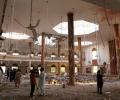
The Bahawalpur centre is notorious for hoarding arms and ammunition left behind by the NATO forces in Afghanistan, the officials said.
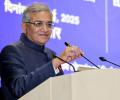
As an IAS officer in Kerala, Gyanesh Kumar -- who the Congress described as Amit Shah's 'right hand man' -- had a good working equation with the state's Congress and Left leaders.
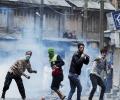
'An entire operation was running systematically prior to the revoking of Article 370.'

Sheikh Sajjad Gul, the head of Lashkar-e-Taiba proxy The Resistance Front (TRF), has been identified as the mastermind behind the Pahalgam terror attack that killed 26 people in April. Gul, who is based in Pakistan, has a history of planning terror attacks in Kashmir, including targeted killings, grenade attacks, and ambushes of police personnel. He was designated a terrorist by the NIA in 2022 and a reward of Rs 10 lakh was placed on his head. The TRF claimed responsibility for the Pahalgam attack, where tourists were shot at point-blank range after being asked their religion. Gul's history includes a 2002 arrest in Delhi for planning serial blasts and a subsequent 10-year prison sentence. After his release, he moved to Pakistan and became the leader of the TRF in 2019, a move orchestrated by the ISI to present a facade of an indigenous terror movement in Jammu and Kashmir.

Social media influencer Orhan Awatramani, known as Orry, and seven others were booked for allegedly consuming alcohol at a hotel in Katra, the base camp for the pilgrimage to Mata Vaishno Devi shrine. The FIR was registered for violating the law and hurting religious sentiments. The hotel reportedly prohibits alcohol and non-vegetarian food due to its proximity to the shrine.
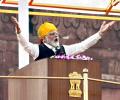
The invitation cards for the 79th Independence Day celebration also carry the Operation Sindoor logo, and the water mark of Chenab bridge to exemplify the rise of 'Naya Bharat'. Floral decorations at the venue will also be based on 'Operation Sindoor'.

A deadly terror attack targeting tourists in Jammu and Kashmir's Pahalgam on Tuesday drew strong condemnation and outrage. 26 people, including two foreigners and two locals, were killed in the attack, which is the deadliest in the Valley since the Pulwama strike in 2019. Prime Minister Narendra Modi asserted that the perpetrators will not be spared and their evil agenda will never succeed. Opposition leaders demanded accountability, claiming the government's claims of normalcy in Kashmir have fallen flat.

Mrs Gandhi's power ebbed and peaked with the times. Mr Modi's has almost been constant, barring the few months of hard dip after the 240 seats of 2024, points out Shekhar Gupta.
India's sporting fraternity, including Olympic medalists Neeraj Chopra and PV Sindhu, expressed grief and condemnation over the deadly terrorist attack in Pahalgam, Kashmir.

Defence Minister Rajnath Singh praised Jammu and Kashmir Chief Minister Omar Abdullah for his efforts to reduce the distance between the hearts of people in Jammu and Kashmir and Delhi. Singh asserted that the BJP government treats Delhi and Kashmir equally, emphasizing a commitment to bridge the gap between the regions. He criticized Pakistan occupied Kashmir (PoK) Prime Minister Chaudhry Anwarul Haq for his remarks against India and reiterated the importance of PoK as an integral part of Jammu and Kashmir.

Congress leader Rahul Gandhi visited Poonch in Jammu and Kashmir, offering condolences to families affected by cross-border shelling and encouraging students who lost two classmates to the violence. During an hour-long visit, Gandhi met with students at the convent school that lost the twins, and visited families whose homes were damaged in the shelling.
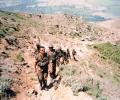
'5465 was over 17,000 feet -- our eyes were out of the sockets by the time we got to the top.' 'We had not eaten in 2-3 days and climbed in extremely difficult terrain.' 'I was there for 5-6 days, but had to be evacuated because I started vomiting blood.'
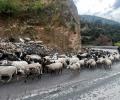
The edited sheep contains no foreign DNA, distinguishing it from transgenic organisms and paving the way for regulatory approval under India's evolving biotech policy framework.
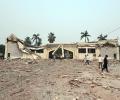
'Operation Sindoor had three objectives.' 'One, destroy the Lashkar-e-Taiba headquarters at Muridke and the Jaish-e-Mohammed headquarters at Bahawalpur.' 'Second, deter and defend any counterstrike by Pakistan.' 'And third, if they persist, demonstrably deliver counterforce punishment.' 'All of the three boxes, the IAF checked,' points out Shekhar Gupta.

Chief of Defence Staff General Anil Chauhan emphasized the need for constant high military preparedness, citing Operation Sindoor as an ongoing example. He also highlighted the importance of 'information warriors, technology warriors and scholar warriors' in future warfare.
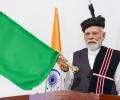
In the last 11 years, India and the world witnessed what he stood for, what he promised and did not deliver, and what he actually stood for and practised without fearing how history would judge him. Modi's tenure has been punctuated with headline-grabbing decisions, symbolic gestures, and stage-managed moments that continue to define his leadership and India's politics, points out Ramesh Menon.

Umar Ganie captures glimpse of actor Ranveer Singh in action in snow covered Gulmarg during the shooting of a romantic song for Karan Johar's film Rocky Aur Rani Ki Prem Kahani.
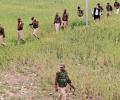
The bodies of a teenager and his two relatives were found near a waterfall in Jammu and Kashmir's Kathua district three days after they went missing. The Jammu and Kashmir Congress has demanded a high-level investigation into the incident. The police have ruled out any terror angle, but the exact cause of death is unknown and will be determined by a postmortem.
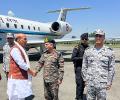
Defence Minister Rajnath Singh on Thursday questioned the safety of nuclear weapons in the hands of Pakistan, and said they should be taken under monitoring of the International Atomic Energy Agency.

People along the Line of Control and International Border in the Jammu region continue to live under the shadow of death, with unexploded mortar shells fired by Pakistani troops still embedded in farmlands and residential areas even though hostilities have stopped for nearly a week. IMAGE: Kindly note that this image has been posted for representational purposes only. Photograph: / Rediff.com Despite the May 10 understanding between India and Pakistan, locals describe the border areas as a 'death trap'. Sixty-two-year-old Balvinder Singh, who returned to his home in Pargwal sector on May 14, recounted a narrow escape. "Two shells exploded in our compound, damaging our house. Three more landed on our farmland. We were terrified and told our family to stay away from the fields until the Army could help," Singh told PTI. Army engineers later came to the village and safely defused the unexploded shells, bringing a temporary sense of relief. "Fear is writ large on the faces of people to these death traps in border hamlets", he said. Scenes of destruction are evident rooftops torn apart, broken houses, windows punctured by shrapnel, and carcasses of cattle lying in pools of blood. The acrid smell of gunpowder still lingers in the air. Sardar Gurmeet Singh faced a similar ordeal. His family could not re-enter their home as a live mortar shell had sunk into the compound in a village close to the International Border. "The army's bomb disposal squad removed it after four days, allowing us to finally enter, back home," he said. Indian Army engineers have launched a sweeping clearance operation across border districts, defusing over 80 unexploded shells in the past five days -- including 6 in Pargwal, 19 in Rajouri, 42 in Poonch, and 12 along the IB. "These shells, mostly 120 mm calibre, have a range of 15 to 30 km and pose a serious threat to both civilian and military targets," an Army officer said. "Many of them were fired by Pakistan during recent hostilities." On May 7, the Indian Army launched Operation Sindoor, conducting precision strikes on nine terror hubs in Pakistan and Pakistan-occupied Jammu and Kashmir (PoJK) in response to the April 22 terror attack in Pahalgam that killed 26 people, most of them tourists. The subsequent retaliation by Pakistan pushed the region to the brink of war. From 7 to 10 of May, 27 civilians were killed and over 70 injured in Pakistani shelling in the Jammu region. Farid Din Gujjar, a resident near the border, expressed fear about returning to his fields. "Several shells created deep craters in our paddy land. We cannot resume work until all unexploded ordnance is cleared. It's a death trap," he said. Army units, in coordination with Jammu and Kashmir Police, have evacuated high-risk zones and issued stern warnings to residents not to touch any suspicious objects or unexploded shells. In one major operation, 42 live shells were safely destroyed in the Poonch villages of Jhullas, Salotri, Dharati and Salani. "All safety protocols were followed. The shells posed a serious danger to local lives," an Army spokesperson said, calling the effort a 'continued commitment to protect civilians and restore normalcy'. Poonch saw the vast majority of deaths due to shelling. Security officials said that Pakistan used a mix of mortar shells, armed drones, and missiles during the shelling spree, specifically targeting civilian habitations and border towns in Jammu, Samba, Kathua, Rajouri, and Poonch. As clearance operations continue, the border residents are slowly returning to their homes, but with caution, fear, and lingering uncertainty about shelling that may yet happen in the future.

A villager was killed and three others were injured in shelling by Pakistan in forward areas of Jammu and Kashmir's Poonch and Rajouri districts early Friday morning, prompting Army troops to retaliate. The shelling also caused significant damage to property, with many houses and hundreds of vehicles affected. The firing and shelling were directed at areas in Rajouri, Poonch, and Jammu districts, apart from Kashmir's Kupwara and Baramulla districts, overnight.
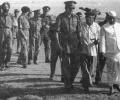
In what was perhaps the most critical meeting before full-scale war broke out, Shastri defined India's immediate war objectives to his defence minister, army, and air force chiefs: 'To defend against Pakistan's attempts to grab Kashmir by force and to make it abundantly clear that Pakistan would never be allowed to wrest Kashmir from India; To destroy the offensive power of Pakistan's armed forces...' A fascinating excerpt from Shiv Kunal Verma's must-read 1965: A Western Sunrise India's War With Pakistan.
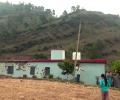
Heavy Pakistani shelling in the border district of Poonch in Jammu and Kashmir left nine people dead and 28 injured. The shelling, described by residents and officials as "barbaric and cowardly", started around 2 am, damaging dozens of residential houses, shops, vehicles, and heritage sites. The incident comes after India launched "Operation Sindoor" in retaliation to the April 22 Pahalgam terror attack. India condemned the act, calling it a cowardly attack on civilians, and reaffirmed that civilian safety remains its top priority.

After finishing the Amarnath Yatra, Saina Nehwal is enjoying the beautiful sights around Kashmir.
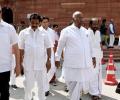
Leaders of 16 opposition parties demanded a special session of Parliament on Operation Sindoor in a letter to Prime Minister Narendra Modi as Indian National Developmental Inclusive Alliance (INDIA) parties held a meeting on the issue in the national capital on Tuesday.

India on Thursday night swiftly foiled Pakistan's attempts to hit various key Indian installations including military stations at Jammu, Pathankot and Udhampur with drones and missiles, the defence ministry said.

The Supreme Court on Thursday refused to examine a public interest litigation (PIL) seeking a judicial probe into the April 22 Pahalgam terror attack in which 26 people were killed.

The revelation may have come late in the century but the Congress disclosed on Thursday, May 29, 2025, that the Indian Army conducted six surgical strikes against Pakistan during UPA-2, the Congress-led United Progressive Alliance government's second term in power.
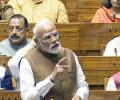
What was the aim of Operation Sindoor? Why was the operation halted so soon? asks Lieutenant General Prakash Katoch (retd).
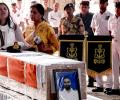
'Let his soul rest in peace...We should all be proud of him in every way. And we will make him proud in every way'
